


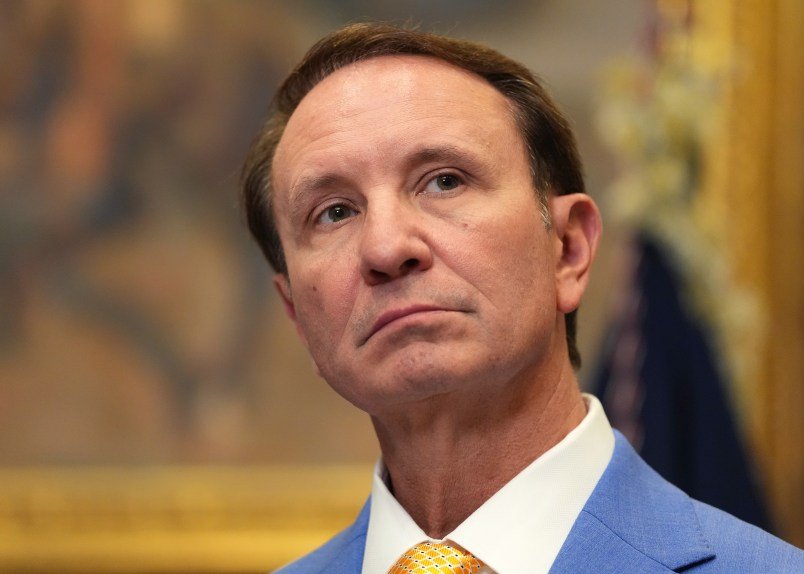
In the aftermath of a Supreme Court ruling this week that struck down Louisiana’s second Black-majority congressional district in Louisiana v. Callais and dealt a devastating blow to the Voting Rights Act, limiting the use of consideration of race in future maps, Louisiana’s Republican Gov. Jeff Landry has suspended this month’s already-active congressional primary election to give lawmakers time to pass new gerrymandered maps ahead of the midterms.
Over 100,000 mail-in ballots have already been sent out and absentee ballots have already been cast for the state’s primary congressional election, which was set to take place on May 16, with a potential runoff set for June 27. Landry’s unprecedented decision to suspend an already-active election garnered praise from Republicans and legal action from Democrats. It also bolsters President Donald Trump’s months-long and previously-floundering nationwide redistricting blitz.
A newly gerrymandered congressional map in Louisiana has the potential to give Republicans one or two additional congressional seats in the midterm elections, further complicating the ongoing Trump’s redistricting war, which up until the Supreme Court ruling this week, Republicans appeared to be losing.
“The best way to end race-based discrimination is to stop making decisions based on race,” Landry said in a Thursday executive order, suspending the election. “Here in Louisiana, we’re proud to lead the nation on this charge. Allowing elections to proceed under an unconstitutional map would undermine the integrity of our system and violate the rights of our voters. This executive order ensures we uphold the rule of law while giving the Legislature the time it needs to pass a fair and lawful congressional map.”
In a federal lawsuit filed on Thursday immediately following Landry’s announcement, a group of voters sued Landry, Louisiana Secretary of State Nancy Landry (no relation), as well as Attorney General Liz Murrill, arguing that the suspension of an active election is unconstitutional.
One of the plaintiffs in the case is voter and Democratic U.S. House candidate Lindsay Garcia, who is running in Louisiana’s 5th District.
“This Court is asked to do something simple: stop a state from canceling an election that is already underway,” the lawsuit says. “Thousands of absentee ballots have been mailed to Louisiana voters, including elderly, disabled, hospitalized, and student voters, as well as active-duty military servicemembers stationed at home and overseas.”
“Treating identically situated voters differently, counting some early ballots and voiding others, or voiding the federal-primary portion of a ballot while counting the same elector’s votes for state Supreme Court and constitutional amendments on the same ballot, violates the equal-protection principles of Bush v. Gore, 531 U.S. at 104–05,” the complaint says.
Plaintiffs are asking for an emergency order from the state to allow the election to proceed as previously planned.
Meanwhile, Republicans have been celebrating the decision and the opportunity to expand Trump’s gerrymandering assault — which he began last summer by pressuring red state legislatures to engage in mid-cycle redistricting to try to predetermine the results of the midterms and maintain Republican control of the U.S. House.
In a post on Truth Social on Thursday, Trump celebrated Landry’s executive order.
“Thank you to the Great Governor of Louisiana, Jeff Landry, for his leadership on the very important Callais case, and for moving so quickly to fix the Unconstitutionality of Louisiana’s Congressional Maps,” he wrote. “He has shown tremendous Vision, Strength, and Leadership. Thank you Jeff, keep up the GREAT work! President DONALD J. TRUMP.”
Speaker Mike Johnson similarly supported the decision, telling reporters on Thursday just prior to the announcement that Landry “has no choice but to suspend it”
“The court has ruled our map unconstitutional,” he added, per Politico.