
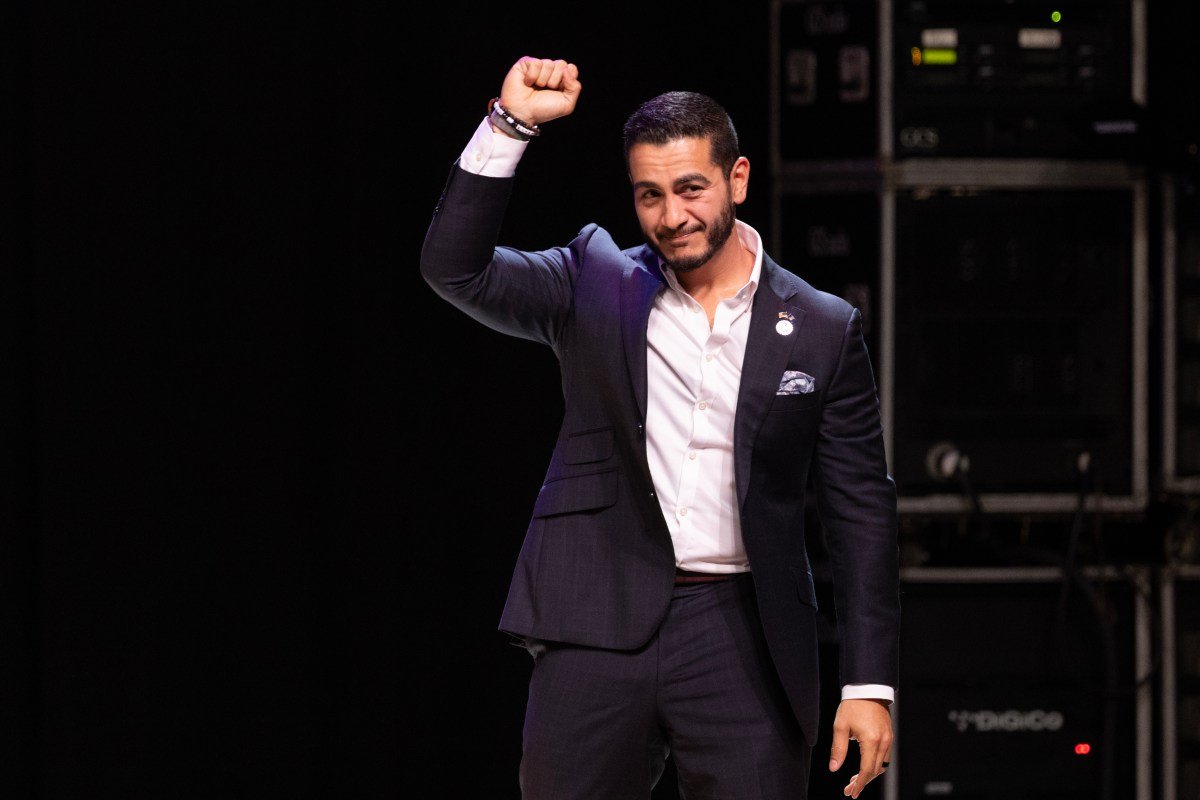
Progressive Democratic Senate nominee Abdul El-Sayed has defeated Rep. Haley Stevens (D-MI), the pick of Senate Minority Leader Chuck Schumer (D-NY).
The race was much closer than polls foretold, with a late glut projecting as much as a double-digit El-Sayed victory. The Associated Press called the race just before 10 a.m. ET on Wednesday.
The acrimonious race has become a microcosm for the bigger questions bedeviling the Democratic primary: Have establishment Democrats 2024ed their way to irrelevance? Can lefty Democrats translate grassroots enthusiasm into statewide wins?
And a less philosophical but more immediate question: Does El-Sayed have enough time to consolidate support after a nasty primary?
It’s a serious blow to Schumer and the greater Democratic establishment, watching another anointed candidate be rejected by voters after Gov. Janet Mills’ Maine Senate campaign landed with such a thud that she couldn’t even make it to primary election day.
Stevens and El-Sayed split on major issues: ICE reform versus elimination, improvement of the Affordable Care Act versus Medicare for all, Schumer for leader versus Schumer banished.
No issue dominated the primary like the growing schism in Democratic politics between supporters of military aid to Israel and those who have soured on it. That was in part by design; El-Sayed, feeling in step with a base that increasingly supports cutting Israel off while it decimates Gaza, raised the issue constantly. And it was in part inevitable, after Stevens raked in $30 million from the American Israel Public Affairs Committee (AIPAC) and once said (as voters were endlessly reminded) that “Israel comes to me in my dreams.”
El-Sayed will run against Republican Mike Rogers in the general election, a former congressman who narrowly lost to now-Sen. Elissa Slotkin (D-MI) in 2024. Rogers, an ex-FBI special agent, was a fairly normal, intelligence-focused Republican during his House stint from 2001-2015. In 2020, he wrote an op-ed in the Washington Post calling on President Donald Trump to concede after the “free and fair” election.
But he, like every Republican with political ambition, hopped aboard the election denier express, spouting pablum about a van of ballots being sent to a polling place in Detroit during his 2024 election. Two of his county chairs participated in the “false electors” scheme in Michigan before being pardoned by Trump, per the Michigan Advance.
The stage for settling the big electability question is set. Can a progressive win against a solid Republican candidate in a purple state? Will the electorate’s rejection of establishment figures usher in a new era of Democratic politicians, or will it result in the fumbling of critical and winnable seats?