
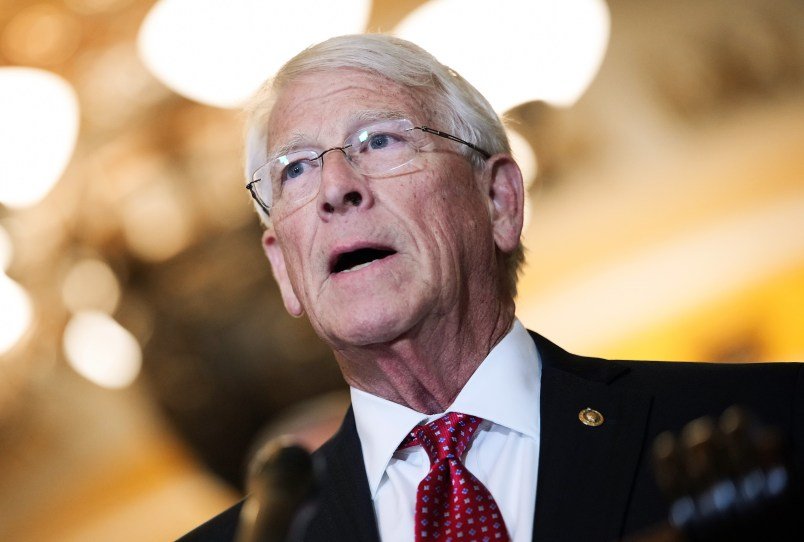
Senate Armed Services Chair Roger Wicker (R-MS) criticized President Donald Trump’s supposed peace deal with Iran on Thursday, saying he is concerned the agreement “negotiates away the victories of Operation Epic Fury.”
“Since day one, I have supported President Trump’s efforts to end Iran’s 47-year threat to the United States and our partners. I am concerned that the memorandum of understanding negotiates away the victories of Operation Epic Fury in ways that are completely out of step with the President’s goals,” Wicker said in a Thursday statement.
Wicker’s statement comes after lawmaker complaints that they have not yet received any clear indication of what is in the agreement that is supposed to temporarily end the war Trump launched more than a 100 days ago. The White House sent their “memorandum of understanding” with Iran to Congress on Thursday — but not until after Trump signed it Wednesday night in France.
A copy of the agreement, obtained by Politico, lays out 14 points the two countries reached — one of them being a $300 billion fund for Iran’s reconstruction and economic development. Though draft versions of the agreement indicated that the U.S. and other allies would help finance Iran’s reconstruction costs, Trump has said that the U.S. will not contribute taxpayer dollars to the fund. Administration officials told Politico that the money would come from regional partners. Here’s how the agreement describes the fund:
The United States of America undertakes, with regional partners, to develop a definitive mutually agreed plan with at least USD 300 Billion, for the reconstruction and economic development of the Islamic Republic of Iran. The mechanism for the implementation of this plan will be finalized as part of final Deal within 60 days. All required licenses, waivers and permissions needed for the relevant financial transactions will be granted by the United States of America.
The Mississippi Republican said he is specifically worried about this fund.
“The $300 billion fund for the reconstruction and economic development of Iran — though not funded by U.S. taxpayers — would make Iran’s payoff under President Obama’s 2015 deal look like a pittance by comparison,” Wicker said in his statement.
He added: “I also oppose the U.S. lifting any sanctions on Iran, or unfreezing Iranian funds, in exchange for Iran’s mere agreement to negotiate for another 60 days. The Iranian regime has not renounced its ultimate goal — ‘Death to America, Death to Israel.’ The regime will invest every penny it receives to further that aim. President Trump has pursued peace through strength. I hope the intermediaries working on this deal are not undermining that objective.”
Sen. Bill Cassidy (R-LA) also criticized the deal, calling it “the worst foreign policy blunder in decades.”
“Reagan is rolling over in his grave,” Cassidy wrote in a social media post on Wednesday. “Iran’s nuclear ambitions were not curbed, and they have learned that threatening the Strait of Hormuz works and will undoubtedly leverage it in the future. Now, Iran gets to build brand-new infrastructure under this deal.”
Reagan is rolling over in his grave. Iran’s nuclear ambitions were not curbed, and they have learned that threatening the Strait of Hormuz works and will undoubtedly leverage it in the future. Now, Iran gets to build brand-new infrastructure under this deal.
Before the war, the…
— U.S. Senator Bill Cassidy, M.D. (@SenBillCassidy) June 17, 2026
Sen. Mike Rounds (R-SD) said that the possibility of the war ending and the Strait of Hormuz reopening are “a step in the right direction,” but, he continued, he worries Iran might use the ability to access frozen assets to support proxy groups in the Middle East.
“I have more concerns about the release of frozen assets,” Rounds said. “If that’s the case, what stops them from using that to fund Hezbollah and other terrorist activities as they have done in the past?”