
The Trump administration is trying to wriggle out of a legal requirement to end its war with Iran, experts told TPM — and to do so, it’s trying to convince everyone to focus on the wrong thing.
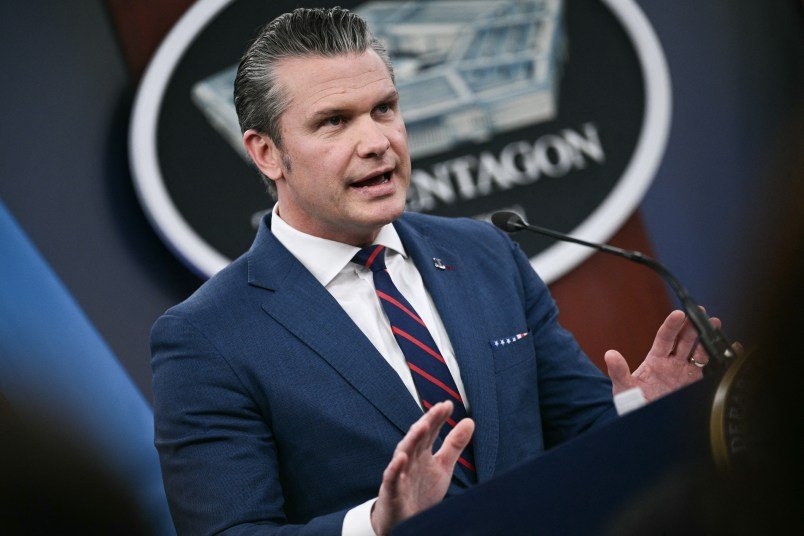
Secretary of Defense Pete Hegseth claimed before Congress Thursday that the administration’s ceasefire with Iran stops the War Powers Resolution’s 60-day clock. White House officials have echoed that line of thinking in statements to the press. But Brian Finucane, a former State Department lawyer and senior adviser in the U.S. Program at the International Crisis Group, told TPM that the claim is not relevant to the current situation. Trump has directed the navy to blockade Iran. That’s an act of war, Finucane said, and likely qualifies as hostilities for the purposes of the law.
“To the extent a ceasefire could entail an end to hostilities, it might. But that’s not the case here,” Finucane said.
In writing the 1973 War Powers Resolution, “Congress understood the term to have a broad meaning, and encompass situations where the U.S. isn’t firing, but where there’s a confrontation,” Finucane argued. “That very much remains the situation in the strait of Hormuz and the Persian Gulf.”
David Super, a professor at the Georgetown Law School, called the administration’s argument “absurd.” Through the naval blockade, the White House is still using the military for the purposes of the law.
“The active bombing was clearly such a situation so the 60-day clock was started. It can only end with a declaration of war, a statutory authorization of the armed forces continuation, or a presidential declaration that he is withdrawing those forces and needs up to 30 days to do so,” Super told TPM in an email.
Trump wouldn’t be the first president to flout the War Powers Resolution, a 1973 law passed as Congress sought to extricate the U.S. from Vietnam. In 2011, the Obama Administration blew the deadline during its intervention in Libya. There, the DOJ argued that the War Powers Resolution didn’t apply because no U.S. troops were on the ground.
The difference here is scale — Iran can hit back, hard — and the level of effort the administration is putting into its argument. Apart from a briefing to Congress, background calls with journalists, and statements from Hegseth himself at a Senate hearing, there hasn’t been any detailed justification.
“We are in a ceasefire right now, which our understanding means the 60-day clock pauses, or stops, in a ceasefire,” Hegseth said Thursday as he testified in front of the Senate Armed Services Committee.
Hegseth did not say whether the White House will seek future authorization from Congress.
Hegseth’s claim came one day before the Trump administration hit the legal deadline on Friday to stop engaging in hostilities with Iran. The War Powers Resolution mandates the president must either get congressional authorization or withdraw from a conflict 60 days after notifying Congress.
“There’s some serious questions about whether this war was legal anyway. Any ability to go to war without Congress’ approval is limited to urgent threats, which were pretty clearly not present here,” Super, the professor at the Georgetown Law School, told TPM earlier this week. “But even if you disagree about that, once we pass the 60-day point without any approval from Congress, then this will be an indisputably illegal action.”
Following the hearing, Armed Services Chairman Roger Wicker (R-MS) told reporters he has “not been too concerned” about the 60-day deadline. Wicker declined to say whether he thinks the Trump administration should seek approval from Congress.
With the 60-day clock up, the Trump administration and Republicans have also been attempting to define the Iran war as anything but a war.
House Speaker Mike Johnson (R-LA) said on Thursday that the U.S. is “not at war” with Iran.
“I don’t think we have an active, kinetic military bombing, firing or anything like that. Right now, we are trying to broker a peace,” Johnson said on Thursday. “I would be very reluctant to get in front of the administration in the midst of these very sensitive negotiations, so we’ll have to see how that plays out.”
Despite that rhetoric, some Republicans who have been sticking with the president up until now are indicating a shift in their stance and pointing toward the 60-day clock as their reasoning.
Sen. Susan Collins (R-ME) on Thursday became the first Republican to change their stance on the war powers votes Senate Democrats have been forcing on the Senate floor. Collins for the first time voted with Senate Democrats and Sen. Rand Paul (R-KY), who has been in support from the start, on Thursday, to end the war. The attempt was unsuccessful but Collins’ change of heart indicates a possible upcoming shift in some Republicans’ stance.
“As I have said since these hostilities with Iran began, the president’s authority as Commander-in-Chief is not without limits,” Collins said in a Thursday statement. “The War Powers Act establishes a clear 60-day deadline for Congress to either authorize or end U.S. involvement in foreign hostilities. That deadline is not a suggestion; it is a requirement.”
The scale of the conflict with Iran surpasses any other recent unauthorized use of the military, Finucane, the former State Department lawyer, said.
“This is the most significant unilateral use of military force by the White House since the Korean intervention, police action, by Truman,” Finucane said.