
FOX 24 US
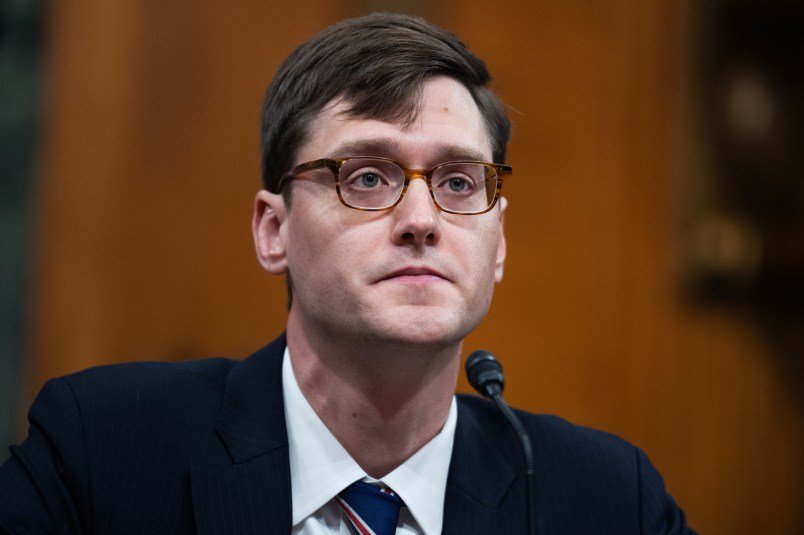
Hal Duncan, President Donald Trump’s nominee to be the deputy director for the Office of Management and Budget (OMB), was in front of the Senate Budget Committee Tuesday morning for the first leg of his confirmation hearing.
Democratic members of the panel grilled Duncan on the actions of OMB Director Russ Vought throughout the first year and a half of Trump’s second term, during which he impounded and — with the help of congressional Republicans — rescinded funds that had been appropriated by Congress, in the process undermining the legislative branch’s power of the purse. Duncan’s responses did not inspire much confidence that, if confirmed, he’d handle the day-to-day operations at OMB much differently.
He is also scheduled to testify in front of the Senate Homeland Security and Governmental Affairs Committee on Wednesday. If confirmed, Duncan — a former staffer of Rep. Chip Roy (R-TX), who currently works in OMB — will replace former congressman Dan Bishop, who is now serving as the interim Attorney for the Middle District of North Carolina.
Here are three takeaways from Duncan’s first round of questioning:
Add Duncan to the List of People Denying Trump Admin Violated the Impoundment Control Act
When asked if he would object to OMB unilaterally refusing to spend money that Congress authorized — in other words impounding funds — Duncan refused to say he would.
“There is essentially a constitutional understanding that has been reinforced by the Supreme Court twice — that the power of the purse cannot be delegated to the president no matter how much the president wants to cancel programs that are authorized and funded or start programs that aren’t funded,” Ranking Member Jeff Merkley (D-OR) said during the hearing. “He doesn’t get to decide that and yet what we’re seeing is programs getting canceled … Will you defend the separation of powers and throw up a cautionary yellow flag and express some concerns if the strategy of OMB is to cancel an authorized and funded program?”
Duncan responded: “As you know, the President ran on restoring the impoundment authority. It’s an authority that presidents had exercised for over 200 years and, that being said, we have been in full compliance with the Impoundment Control Act to date.”
Despite Duncan’s claims, the OMB and the Trump administration were found repeatedly to have impounded federal funds approved by Congress, as documented in several decisions from the Government Accountability Office (GAO), a nonpartisan legislative branch federal agency that examines how federal taxpayer dollars are spent.
Duncan’s answer signals an alignment with Vought’s belief that the administration has the inherent constitutional authority to impound funds. He has testified to this belief himself several times before and he made the same claim in April when he appeared before the Senate Budget Committee.
Duncan Isn’t a No on Pocket Rescissions
In addition to impoundments, over the past year and a half, the Trump White House found other ways to undo appropriators’ decisions, pushing congressional Republicans to authorize a rescissions package last year and championing a pockets rescissions package, which the GAO also found to be outside of the law.
Sen. Patty Murray (D-WA), ranking member for the Senate Appropriations Committee, brought up pocket rescissions during her line of questioning.
“Can you assure all of us that OMB will not attempt to do another end run around Congress with an illegal pocket rescission this September?” Murray asked Duncan.
“I can’t commit to any of the fiscal tools the administration may or may not use in the future,” Duncan responded, also pointing to the Gerald Ford administration’s use of pocket rescissions.
Merkley later pushed back on Duncan’s example, saying that he would not be able to come up with any other instances of pocket rescissions after Ford as there were “several Supreme Court decisions” on the issue.
“One of them made it very clear that, in general, any sort of impoundment is unacceptable and rescission done without Congress is a form of impoundment,” Merkley said. He added that “the Ford example doesn’t at all address legitimacy or illegitimacy. The law still says any rescission must be done and … passed by both houses of Congress.”
Just Another Trump Appointee Unable to Say Biden Won the 2020 Election
Duncan was asked by Democratic senators if he thinks the 2020 election was rigged.
Duncan refused to answer that question directly, instead saying that he believes “Joe Biden was certified as the winner of the 2020 election.”
Duncan’s refusal to answer the question led Sen. Tim Kaine (D-VA) to push harder, beginning his questioning by asking: “Was the 2024 presidential election rigged?”
“Senator, President Trump won the 2024 presidential election,” Duncan answered.
“Yeah, folks, how about that? So he was asked twice, ‘Was the 2020 presidential election rigged?’ and he said ‘President Biden was certified to be the winner.’ He wouldn’t answer the question,” Kaine said, pointing to Duncan’s carefully crafted language in answering the same question in two very different ways.
“Mr. Duncan, you have either fallen victim to the conspiracy mindset that says that that election was rigged — and if you’re a conspiracy theorist, you shouldn’t be let anywhere near the position you’ve been nominated for,” Kaine continued. “Or you know President Biden won the election but you’re afraid of making an insecure president mad by acknowledging that fact. You answered so easily when I asked you the question about 2024. You didn’t fight, you didn’t evade, you didn’t obscure, you didn’t try to end run … The answer was just as simple about 2020.”