


When President Donald Trump’s administration began its shakeup of the federal government, purging online data sets and demonizing previous federal policy, Laura Pegram saw that her organization could be in danger. She, along with others at the National Alliance of State and Territorial AIDS Directors, or NASTAD, moved to restructure their website.
“We very intentionally took down all of our staff bios, took down a vast majority of our drug user health resources,” Pegram said. “I still have them, of course. Just like I have all of the CDC and SAMHSA pages that used to affirm the evidence base behind syringe services programs, harm reduction programs.”
Pegram is the director of drug user health at NASTAD. The membership-based organization serves state, local, and U.S. territory public health officials who administer state and federal funding for HIV/AIDS and other public health programs.
In July 2025, Trump signed an executive order that took aim at her work and established a turning point for federal drug policy: grants from the the Substance Abuse and Mental Health Services Administration, or SAMHSA, could no longer be used to fund harm reduction programs. In the months since, the administration has enacted a series of confusing and contradictory policy measures that’ve left substance use treatment providers and advocates reeling, searching for creative ways to keep their work afloat, and worrying about the potentially fatal consequences of unstable federal guidance about overdose prevention.
Experts told TPM the administration’s targeting of the term “harm reduction” specifically risks obscuring lifesaving substance abuse treatment programs. Fear over losing federal grants has already driven some programs to reevaluate their offerings, or at least the language they use to talk about it.
“We’ve had programs whose funders have told them that they’re not allowed to do XYZ because of executive orders, but those executive orders don’t actually say you have to stop doing that,” Amy Lieberman, deputy director of the Harm Reduction Legal Project at the Network for Public Health, told TPM. “It’s just funders being nervous, making decisions based on what they are afraid is going to happen.”
In January 2026, for example, the Trump administration sent out a letter that wiped out $2 billion in substance use and mental health treatment grants, which were immediately reinstated after the cuts drew sharp, bipartisan outcry in Congress.
“Behavioral health, recovery service services efforts, if I’m honest, they maybe have never been under attack in this way,” said Pegram.
SAMHSA block grants give state officials wide discretion for funding overdose prevention, drug user health, and substance use treatment services. But the July 2025 executive order’s tough-on-crime language disavowed the use of federal money for a broad slate of initiatives that experts and public health professionals have credited for the significant drop in overdose deaths over the last several years.
“Endemic vagrancy, disorderly behavior, sudden confrontations, and violent attacks have made our cities unsafe,” Trump’s order starts, before listing stats about homelessness. “The overwhelming majority of these individuals are addicted to drugs, have a mental health condition, or both.”
Harm reduction encompasses a range of services that prevent disease and death, including widely accepted interventions like the overdose reversal medication naloxone, fentanyl test strips, or methadone and buprenorphine for those in recovery — as well as more controversial approaches where professionals help facilitate safe drug use through things like providing clean syringes and other drug paraphernalia.
One glaring issue with the administration’s initiative is that federal money is already barred from directly funding the kinds of harm reduction policies Trump and his “Make America Healthy Again” allies oppose — things like needle sharing programs and safe drug consumption sites. Syringes, smoking pipes, and safer drug use supplies have been off-limits for federal funding since 1989. A 2015 omnibus spending bill lifted parts of that provision, but money still cannot be used to purchase items to use drugs like needles, according to the legislation.
The Trump administration’s order also bans federal housing and homelessness assistance programs from operating safe consumption sites, spaces where people who use drugs can do so more safely under the supervision of medical professionals and with clean tools.
The U.S. Department of Health and Human Services did not respond to TPM’s request for comment, including for examples of federally-supported safe consumption sites on or off federal housing sites. Very few supervised consumption sites actually exist in the U.S. The Supreme Court in 2021 declined to hear a Philadelphia-based case about the legality of such a site.
‘It Has Fatal Consequences’
The July order apparently caused such confusion among providers that SAMHSA issued a letter five days later clarifying that, as it turns out, grants could still fund myriad harm reduction measures. But the agency is trying to stigmatize the term, despite its widespread acceptance.
“In recent years, the life-saving opioid overdose reversal medications (OORMs), naloxone and
nalmefene, have been lumped into an ideological concept of harm reduction which has been
used to advocate for policies that are incompatible with Federal laws and inconsistent with this
Administration’s priorities,” Art Kleinschmidt, a Project 2025 author who was leading SAMHSA at the time, wrote in the letter.
Despite all the administration’s rigid posturing over semantics, SAMHSA’s guidance affirmed that most of the previously federally funded harm reduction initiatives continue to qualify for grants, experts told TPM. Like many of Trump’s more divisive orders, the White House’s attack on harm reduction is viewed by some advocates as more symbolic than legally impactful.
“It was ugly language,” Pegram said of SAMHSA’s letter. “It was mean. But what it did do, which was, I believe, very intentional, [was] affirm all the things you can still use SAMHSA money to purchase in those contexts.”
Still, advocates told TPM that programs offering harm reduction services, even those acceptable under SAMHSA’s new guidance, are becoming overly cautious to avoid losing funding.
“The ones that are actually housed within … government institutions are seen to be not only having more pushback and changing their narrative, but also giving in easier,” Lieberman said.
A former SAMHSA employee who left the agency after Trump began cutting federal staff and compromising public health programs spoke to TPM on the condition of anonymity. The former employee expressed concern that some state and independent programs will — or have already — preemptively respond to Trump’s executive order at the expense of permissible treatments.
“There’s… a lot of over-interpretation or misinterpretation of these things that’s leading to programs who have saved thousands of lives in their communities no longer receiving funding very suddenly,” the former employee told TPM. “It has fatal consequences.”
Kennedy Calls Harm Reduction ‘Non-Effective’ … Before Kind of Expanding It
HHS Secretary Robert F. Kennedy Jr. has joined Trump in lambasting harm reduction in word, if not always deed.
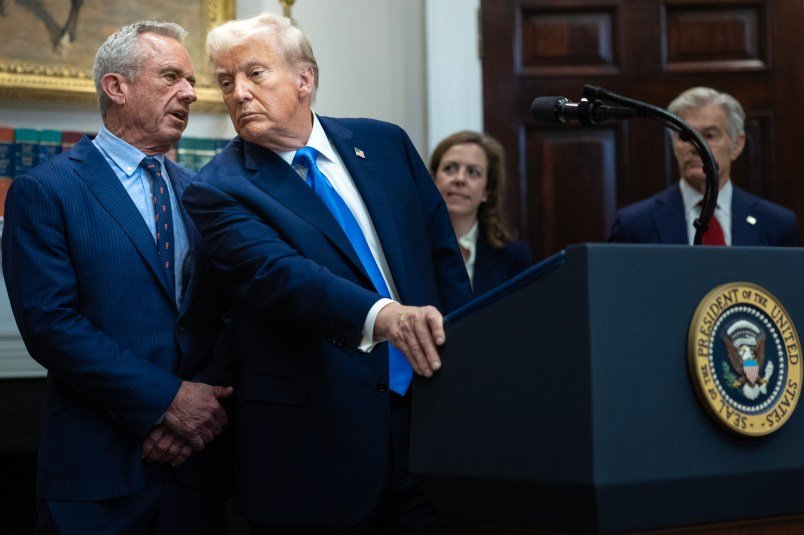
Kennedy stood with Trump in January when the president initiated his administration’s alternative to dealing with the national drug crisis. Called the Great American Recovery Initiative, the accompanying executive order established a bureaucratic task force of government-wide department heads. It does not mention the words harm reduction.
Kennedy days later announced his department’s new substance abuse treatment plan. A marquee program inside the Safety Through Recovery, Engagement, and Evidence-based Treatment and Supports, or STREETS, Initiative, is a $10 million investment into grants that support court-ordered drug and mental health treatment. A STREETS press release does mention the words “harm reduction,” calling it “non-effective,” but then goes on to announce the expansion of federal funding for three new opioid use disorder medications which are themselves harm reduction tools.
Critics in the Trump administration and Make America Healthy Again movement claim that harm reduction enables drug use, but mainstream public health professionals broadly consider it to be a gold standard in overdose and disease prevention, and credit it for a recent drop in overdose deaths.
Overdose deaths have declined steadily since 2023, according to CDC data after the opioid crisis helped fuel a dramatic increase in U.S. overdose deaths beginning around 2013. Deaths reached their lowest level since 2019 at the end of 2025, according to CDC data published in May. An HHS webpage that’s still accessible online touts the department’s previous support of harm reduction services like fentanyl testing strips and a monitoring mechanism to assess the effectiveness of syringe exchange programs. It links to research published by Science Advances, a peer-reviewed scientific journal, that found the three strategies most effective for preventing future overdose deaths are “fentanyl-focused harm reduction services,” increased access to naloxone, and general recovery support. The nonpartisan Congressional Budget Office in January published a report touting access to overdose reversal medications as a harm reduction approach that has reduced overdose deaths without increasing opioid use. Even SAMHSA itself admitted in Kleinschmidt’s July letter that overdose deaths under former President Joe Biden declined by 26% between February 2024 and February 2025.
Still, in April 2026, SAMHSA dropped fentanyl and other drug testing strips from eligibility for federal funding. The move led Sen. Ron Wyden (D-OR) and a slate of other Democratic representatives to urge Kennedy to reverse course.
“Doing away with this mainstay of overdose prevention runs directly counter to this administration’s own promises to crack down on the addiction epidemic in the United States,” the senators wrote in a letter. “We demand that you reinstate this funding before American lives are lost as a direct result.”
Through it all, Pegram and NASTAD have stayed nimble, tweaking wording while keeping their programs running in order to protect themselves and their clients from attacks on their work by the administration.
“That has forced us to start shifting all of our language,” Pegram said. “We don’t shift what we do but we just have to call it something else now. ‘Infectious disease and overdose prevention among people who use drugs.’ Like, if that’s what you need to call it, that’s what you need to call it.”