



The Trump administration is waging war on Iran without congressional authorization, violating a key constitutional principle while further sidelining a supposedly co-equal branch of government, experts told TPM.
But there’s one veto Congress retains to stop Trump’s ongoing assault in Iran: appropriations.
It’s the biggest and sole remaining source of real leverage that Congress has to compel an end to the war with Iran, Brian Finucane, a senior adviser at International Crisis Group and a former lawyer in the State Department’s Office of the Legal Adviser, told TPM.
“The ultimate war power is the power of the purse,” Finucane said.
Congress scheduled votes on separate, bipartisan war powers resolutions this week. The Senate on Wednesday failed to advance a war powers measure that would have called on Trump to end the strikes. The House is set to vote on a similar proposal on Thursday. They are largely considered messaging bills to get members on the record; even if either resolution made it to President Trump’s desk, he would likely veto the measure.
Congress has used its power over spending in the past to end U.S. military operations abroad. Lawmakers brought an end to American involvement in the Vietnam war this way, and voted to block funding that was being used to bomb Cambodia.
That point of leverage can go both ways.
Katherine Ebright, a counsel at the Brennan Center’s Liberty and National Security Program, told TPM that past presidents have cited military appropriations bills passed during an unauthorized war to argue that it’s approved American participation in the conflict. The law there is not yet finalized, Ebright added.
“The Supreme Court has never resolved whether appropriations can stand in for a war authorization,” she said.
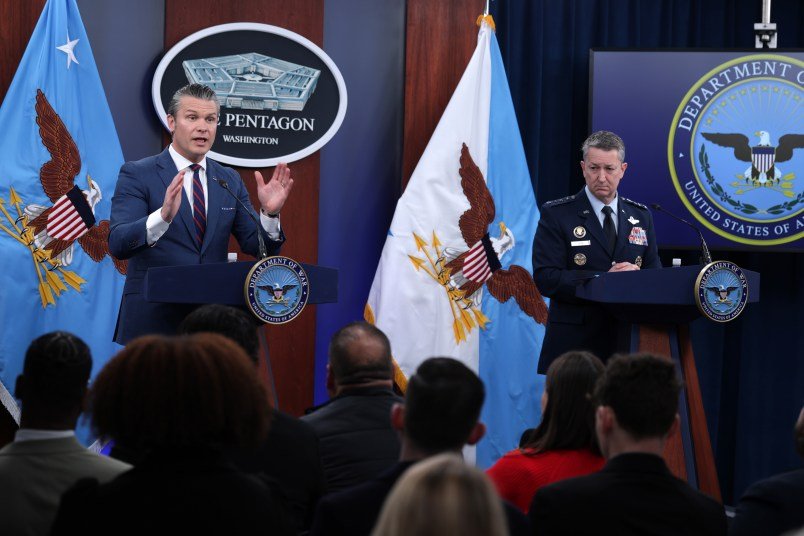
The Trump administration is reportedly gearing up to ask Congress to pass an emergency supplemental military funding bill, or an appropriations bill, for its war in Iran. There hasn’t been any evidence to back up the evolving rationales the Trump administration has provided to the public for the strikes, which began on Feb. 28. In the first days, Trump and other senior officials said that the war would last for days. This week, Secretary of Defense Pete Hegseth said that it would last for up to four weeks. On Wednesday, Hegseth said that it could last up to eight weeks.
Government officials have not met that expanding timeline with a clear objective for the war. They’ve said regime change and not regime change, and have argued that it’s aim is to eliminate Iran’s capacity for offensive operations. Israel may have aims that diverge from those that the U.S. is pursuing, per some reports.
There was little to no argument from the administration before the war for why one should begin. To Finucane, the last week “illustrates very clearly why the U.S. Constitution requires congressional authorization to wage war.”
“We could have had a public debate about whether this expenditure of blood and treasure is worth it. We have a collective decision-making body of the people’s elected reps to weigh in as the administration makes its case,” he added. “None of that happened here.”
Republicans have largely supported the prospect of emergency war funding. Politico quoted Senate Minority Leader Chuck Schumer (D-NY) as saying, “before you can feel satisfied about a supplemental — and I haven’t seen it — you have to know what the real goals are and what the endgame is.”
Sen. Chris Coons (D-DE), a senior Democrat on the Senate Appropriations Committee, told the outlet that the Pentagon would likely ask for supplemental funding and that he intended to “make sure we are making all the investments we can” to safeguard American troops.
Trump notified Congress of the strikes on Tuesday, citing his “responsibility to protect Americans and United States interests” and saying it was “pursuant to [his] constitutional authority as Commander in Chief and Chief Executive to conduct United States foreign relations.”
The lack of prior authorization has reportedly prompted other lawmakers to mull forcing a vote on an Authorization for the Use of Military Force (AUMF) that would give Trump an explicit thumbs up on the war on Iran, another effort to get lawmakers on record. That, Ebright suggested, could trigger other threats to civil liberties should it pass.
“There are a whole host of domestic authorities that become available to the president in times of war,” she remarked.