




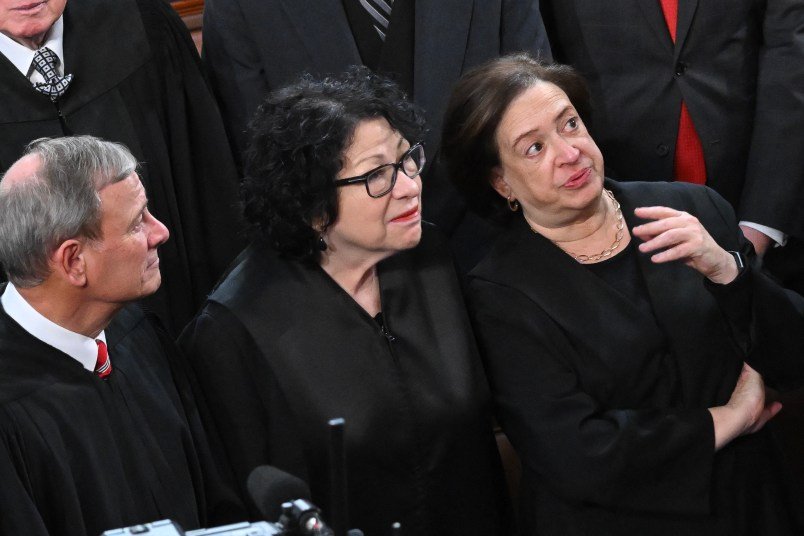
The Supreme Court ruled against Colorado’s conversion therapy ban for minors Tuesday in an 8-1 decision, with Justices Sonia Sotomayor and Elena Kagan joining the conservatives.
Justice Ketanji Brown Jackson was the sole dissenter.
Kaley Chiles, a licensed counselor in Colorado, had sued, arguing that the law violated her First Amendment rights by preventing her from helping patients to “reduce or eliminate unwanted sexual attractions, change sexual behaviors, or grow in the experience of harmony with their bodies.” The law explicitly encourages therapists to support those transitioning or exploring their gender identities.
Justice Neil Gorsuch, writing for the majority, said that Colorado’s law is textbook viewpoint discrimination.
“On the view Colorado and the dissent advance, a law adopted during that era prohibiting counselors from engaging in the ‘substandard care’ of affirming their clients’ homosexuality would have been subject to only rational-basis or intermediate-scrutiny review — and likely upheld,” he wrote.
Kagan, joined by Sotomayor, concurred. She wrote that when the state suppresses one side of a debate, “the constitutional issue is straightforward.”
Jackson advanced a dissenting theory, arguing that states may infringe on the treatment-related speech of medical providers when it’s part of a larger regulation to ensure that patients get high-quality medical care.
A state, she wrote, may “prohibit a doctor from encouraging a patient to commit suicide, or a dietician from telling an anorexic patient to eat less. Likewise, no one would bat an eye if a State required its doctors to discourage, but not encourage, smoking tobacco.”
“My colleagues’ contrary conclusions are puzzling, for a standards-based healthcare scheme cannot function unless its regulators are permitted to choose sides,” she added.
In a jab at her right-wing colleagues, she cited United States v. Skrmetti, in which the majority upheld a Tennessee ban on gender-affirming care for trans minors. In that decision, the Court ruled that minors could receive certain care — puberty blockers, hormones — but only if that treatment was for diagnoses other than gender dysphoria.
Chiles’ initial lawsuit did not challenge the parts of Colorado’s law that banned the once-common and brutal medical practices, including electroshock therapy, that were part of conversion therapy.
Read the ruling here: