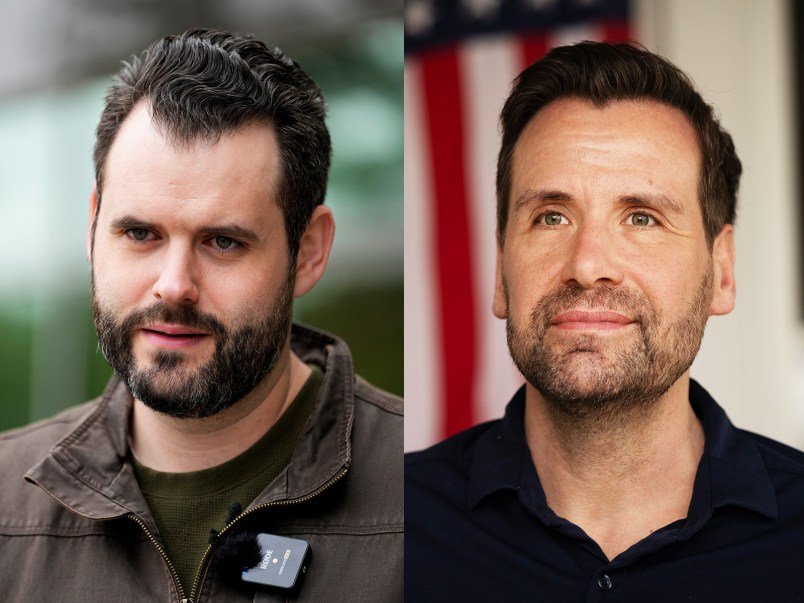
Two young state lawmakers are competing in Tuesday’s primary for the chance to be Iowa’s next and long-awaited Democratic senator in a year where they might just have a chance.
The two candidates, state Sen. Zach Wahls (D) and state Rep. Josh Turek (D), espouse similar ideologies but took different byways to national prominence. Wahls went viral at 19, when he delivered a speech to the Iowa state legislature in defense of gay marriage (Wahls has lesbian mothers). Turek, a gold medal Paralympian in wheelchair basketball twice over, in 2022 flipped a state House seat that had gone for Donald Trump by 17 points two years earlier. Turek snagged a win by six votes, expanding that tiny margin to a respectable five percentage points when he ran for reelection two years ago.
That electoral experience is the cornerstone to Turek’s pitch: He’s won in red terrain and can do it again. Succeeding in hostile territory will be a requirement for either Democratic candidate in a state that voted for Trump three times (by a whopping 13 percent in 2024) and where Republican registered voters outnumber Democrats by 200,000.
Wahls’ electability argument is shakier: He represents a district in deep blue Johnson County, home to the University of Iowa, and has never run against a Republican.
Cognizant of his disadvantage, Wahls has sought to shift the conversation, casting Turek as unacceptably cozy with a Democratic establishment that even base voters currently despise. Turek, he says, is the choice of boogeyman Senate Minority Leader Chuck Schumer (D-NY) and won’t provide the fight and new energy Democrats crave. Turek has been noncommittal when asked whether he would support Schumer for majority leader.
A track record of success in red country versus a progressive fighter disdainful of unpopular party leadership — this is the choice Iowa Democrats will make Tuesday.
In an echo of Texas’ Senate primary featuring Rep. Jasmine Crockett (D) and now-nominee state Rep. James Talarico (D), primary voters are making their selections not just according to personal preference, but with the knowledge that the door is finally cracked for a Democrat to burst through.
As has been the case since the 2010s, Iowa is a reach for Democrats. The white working class migration to the Republican Party has made a state that twice voted for Barack Obama a deep-red stronghold. The state’s last Democratic senator, Sen. Tom Harkin (D) (who has endorsed Turek), left office in 2015. He was succeeded by Sen. Joni Ernst (R), who is now retiring. The state currently has an all-Republican federal congressional delegation, and the GOP has reigned with a trifecta in the statehouse for almost 10 years.
But some crucial things have shifted. Ernst and Gov. Kim Reynolds (R) bowing out has left both posts open for the first time since 1968. Rob Sand, the state auditor and rare Democrat who has won statewide, is running such a formidable gubernatorial campaign that the Cook Political Report rates it a pure tossup. The gruesome national environment has infected Iowa too, where Trump’s approval is underwater at 42 percent. The agriculture-dependent state has been doubly thwacked with tariffs and high fertilizer and gas costs from the war in Iran.
And Democrats had a good run in 2018, a blue wave environment, where they came close to the governor’s mansion and picked off two House seats. At least two seats are hotly contested this time too — those held by Rep. Mariannette Miller-Meeks (R), who drastically underran Trump last cycle, winning by a fifth of a percentage point, and Rep. Zach Nunn (R), who won in 2024 by four points.
National Republicans have the state on their radar, already committing $29 million to the race. The Democratic nominee will face Rep. Ashley Hinson (R), who easily cleared the field after Ernst decided to retire following her “we are all going to die” gaffe. Hinson’s open seat is a reach opportunity for Democrats, potentially gettable if a blue tsunami develops.
An upset Senate win in Iowa would get the Democrats closer to their very difficult climb to a majority, but it would also show that the party is viable in states recently considered lost. Given the Republican slant of the upper chamber of Congress, Democrats will have to start showing competitiveness in states like Iowa if they ever want a sizable majority.