



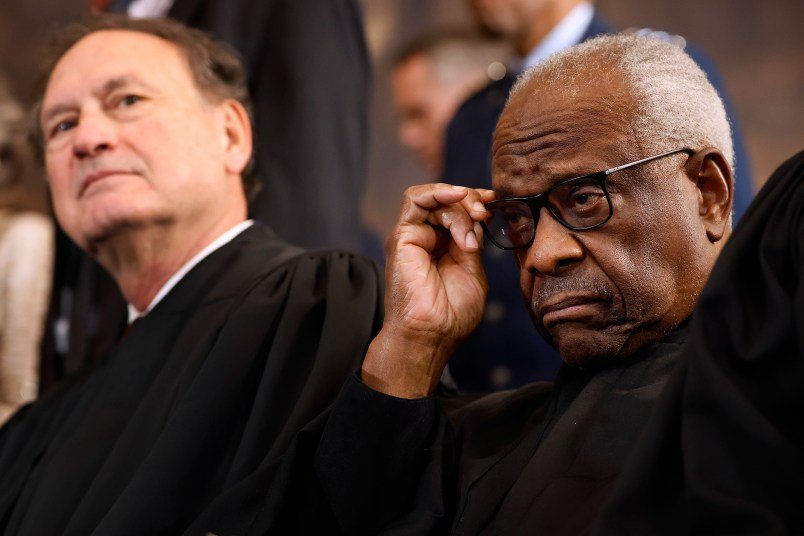
To Justice Samuel Alito, Tuesday’s 6-3 decision upholding birthright citizenship is both “one of the most important decisions in the history of the Court” and a “serious mistake.”
To Justice Clarence Thomas, birthright citizenship’s days are numbered.
“I am not sure that today’s opinion will stand the test of time,” Thomas wrote. “The Citizenship Clause ‘added greatly to the dignity and glory of American citizenship,’” he added, citing a dissent in Plessy v. Ferguson. “Today’s opinion devalues that citizenship.”
Four justices disagreed in some form or another with the majority on Tuesday, which held that the Constitution guarantees birthright citizenship. Justice Brett Kavanaugh concurred with the majority but argued that birthright citizenship is guaranteed by statute, culling it from the Constitution and kicking the question to Congress.
The dissents — and Kavanaugh’s concurrence — lay the groundwork for a world in which a future Supreme Court strips the Constitution of birthright citizenship. Doing so would contradict decades of practice and interpretation, revising a fundamental constitutional principle established in the wake of the Civil War.
But the concurrence and dissents Tuesday demonstrate that, on this court, four justices, including Neil Gorsuch, are already willing to make that change. To get there, Thomas and Alito cast citizenship as a zero-sum game. Both dissents are full of talking points popular on the right: complaints about birth tourism, suspicion of the children of non-citizens. At one point, Thomas, joined by Gorsuch, attributes the practice of birthright citizenship to two Democratic Presidents, Franklin Delano Roosevelt and Bill Clinton.
But to him, it’s fundamentally an issue of the citizenship of some Americans being devalued by the idea that it can be obtained as a matter of birth.
After the Civil War, Congress granted citizenship to freed slaves because they were rooted in the land, Thomas wrote. They were Americans, many of whom had fought in the Civil War, and “had no other homeland, owed no allegiance to any foreign power, and were subject to no other authority.”
“The same could not be said for the children of foreign temporary visitors,” Thomas wrote. “Foreign temporary visitors were attached to their home country, lacked similar bonds to this country, and would not be called upon in time of war.”
It’s a remarkably similar argument to one made by Vice President JD Vance, who told the Claremont Institute last year that the concept of U.S. citizenship needed to be changed to accommodate people with long ancestry in the country.
“I think the people whose ancestors fought in the Civil War have a hell of a lot more claim over America than the people who say they don’t belong,” he said at the time.
Alito struck a similar note in his dissent, saying that the majority’s ruling “degrade[s] the concept of United States citizenship.”
At times, Alito conceded that his concern is about the consequences of birthright citizenship. It can lead to “grotesque results,” he argued. “While foreigners who wish to immigrate lawfully must sometimes wait for many years, a child born here to a birth tourist is automatically a citizen.”
It’s a complaint familiar to those who have followed right-wing media and commentary in recent years. There, there’s a separate category of citizen: “Birthright citizens,” people born to undocumented or non-citizen parents who did not hold a green card. Alito cast their status as citizen as an act the Supreme Court took on Tuesday, not a longstanding feature of the Constitution.
“As a result of the events of the past 50 years, the United States now has a huge contingent of people who entered or remained in this country illegally, as well as a large group of people who were born here to such parents,” he wrote. “The Court’s interpretation of the Fourteenth Amendment makes all the members of this latter group citizens.”
Nativists in the conservative movement reacted to the decision with outrage. Stephen Miller, not known for his hesitancy to use hyperbole, called it “one of the most destructive and outrageous decisions in the long history of the Supreme Court.”
Others spun it along the lines that Alito set: this isn’t the Court upholding a fundamental rule, but a new decision that grants citizenship to the children of undocumented immigrants.
Savannah Hernandez, a TPUSA influencer who has cast immigrant communities as an example of the “Great Replacement” conspiracy theory, posted a video of people standing outside a border wall, writing, “under SCOTUS’s new ruling, all of the children born to the migrants who illegally walked into our country are considered ‘US citizens’.” Several Republican senators proposed various forms of legislation to bar the children of undocumented immigrants from becoming citizens upon birth.
President Trump himself echoed Kavanaugh’s suggestion that Congress is best-suited to handle the question, saying that the GOP would “work to correct” the matter in Congress.
In these reactions, Tuesday’s decision doesn’t spell the end of the issue. Rather, it’s the start of a new campaign.