
Last month, the Trump administration insisted that its war with Iran was over, a transparently preposterous claim aimed at sidestepping a legal requirement that Congress authorize hostilities that extend beyond 60 days.
Now, Senate Democrats are preparing to push back on the administration’s assertion.
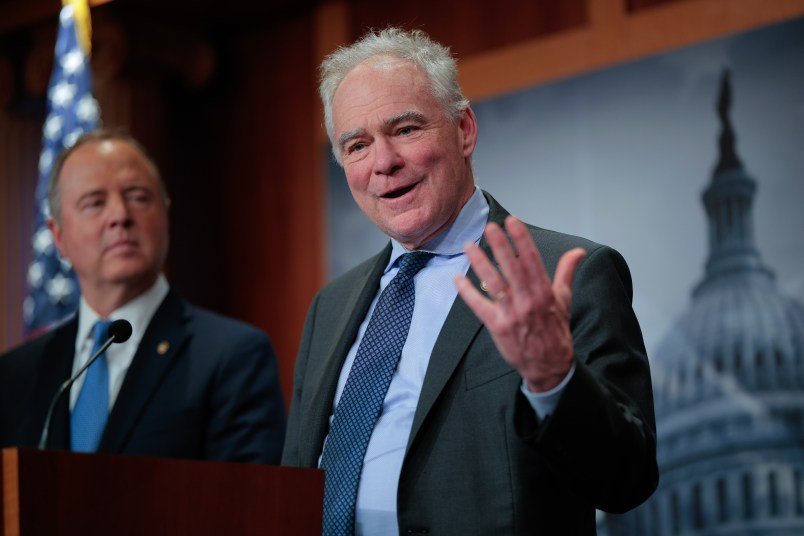
Sens. Adam Schiff (D-CA) and Tim Kaine (D-VA) are circulating a draft letter within the Senate Democratic caucus objecting to the claim that a ceasefire with Iran stopped the 60-day clock on the War Powers Resolution.
Kaine told TPM that he knows “the opinion is widely shared — including among many of our Republican colleagues — that the argument that the 60 days somehow stopped makes no sense.”
Several Senate Republicans have broken with the administration on the issue in the days after the it blew past the 60-day deadline with virtually no effort to involve Congress in the decision making.
“We still have all our troops there, we’re still blockading their ports. There’s still all kinds of military action. So as a matter of fact, it’s wrong,” Kaine told TPM, when asked about the letter. “And second, as a matter of statute, the statute does not contemplate the … stoppage time or something like that.”
TPM obtained and reviewed an early draft of Senate Democrats’ letter. A spokesperson for Schiff’s office separately confirmed to TPM that a draft of the letter is currently circulating within the Senate Democratic caucus.
Democrats’ pushback comes amid efforts by the administration to wriggle out of a legal requirement to end its war with Iran or seek congressional authorization. The War Powers Resolution of 1973 mandates that a president must withdraw from a conflict 60 days after notifying Congress that American forces are fighting. The Trump administration hit that deadline in May.
But in order to avoid requesting that Congress authorize its continued military action — which is highly unpopular on Capitol Hill and would seemingly fail to get the votes needed — the White House sent a letter to Congress on May 1 saying that as far as it was concerned, the war had been “terminated” by a ceasefire.
“There has been no exchange of fire between United States Forces and Iran since April 7, 2026,” Trump wrote in the letter. “The hostilities that began on February 28, 2026, have terminated.”
And Secretary of Defense Pete Hegseth made the same argument to Congress during a set of congressional hearings during which he testified last month, stating that the administration’s ceasefire with Iran stops the War Powers Resolution’s 60-day clock. Secretary of State Marco Rubio stuck with that rhetoric on Tuesday as he testified in front of the Senate Foreign Relations Committee, claiming that the “war is over.”
Booker: You keep telling us how we’re winning this war.
Rubio: The war is over.
Booker: The war is not over. The American people see how we’re losing at the pump and with their costs, and yet this thing still hasn’t been resolved. Every day he tweets out, oh, we’ve obliterated… pic.twitter.com/6fFibxsq4H
— Acyn (@Acyn) June 2, 2026
Trump added in his letter, however, that “the threat posed by Iran to the United States and our Armed Forces remains significant. Accordingly, the Department of War continues to update its force posture in the AoR in select countries, as necessary and appropriate, to address Iranian and Iranian proxy forces’ threats and to protect the United States and its allies and partners.”
Experts who spoke to TPM called the Trump administration’s claims “absurd.”
“I think it was their effort to, frankly, avoid an action like Congress took two weeks ago,” Kaine told TPM, referring to Senate Democrats and four Senate Republicans voting to discharge the Iran War Powers Resolution from committee.
“They were trying to advance some rationale to forestall that day from happening, but the Senate did vote in support of our war powers resolution, and we think the House is going to do the same thing this week,” Kaine told TPM.
The House is expected to take up their own war powers resolution this week. That comes on the heels of House GOP leadership cancelling a vote on the resolution that was on track to pass two weeks ago.
A mass of House Republicans are reportedly planning to break from their caucus and vote with Democrats on a war powers resolution this week.