
FOX 24 US
Maine Senate Thunderdome Here We Come?
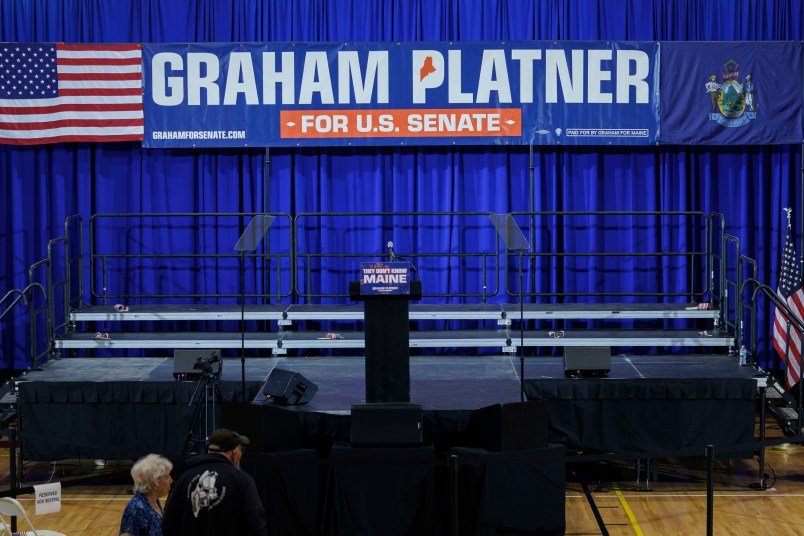
Staring down the prospect of a candidate in a critical race having to be swapped out in July, with four months to go before the general election, Democrats might be feeling some PTSD.
But even before multiple outlets reported a sexual assault accusation Monday night (which Graham Platner denies), there were signs that Platner’s polling was weakening — the result of a months-long drumbeat of scandals, exhausting Democrats of all political stripes.
Still, most polls show the party retains a lead on the generic ballot. Mainers appear to want to send a Democrat to the upper chamber. And under state rules, Platner has until Monday to drop out. State Democrats would then have until the fourth Monday in July — July 27 — to name a replacement candidate, a delicate process that has the potential to anger everyone. (Josh Marshall described proposals for a flash convention to replace Biden in 2024 as “thunderdome” politics — something like that might be in the offing for Maine as well.)
Janet Mills, reportedly, is unlikely to be that replacement candidate, given her sleepy primary campaign. Most attention has focused on candidates who lost the governor primary — Nirav Shah, who lead the state’s public health response through COVID; Troy Jackson, a former president of the Maine Senate; and Shenna Bellows, the current secretary of state, who lost to Susan Collins in the Senate race in 2014.
But first, Platner has to choose to withdraw. Abandoned by the state and federal party campaign organizations and most high-profile allies, he would seem to have little choice. Still, he seems to want to exercise some influence over his successor, a “person familiar” told the New York Times last night.
“If he was to step down it would only be with a guarantee of being replaced by a candidate who he believes is true to the values and vision and policy agenda of the campaign that Maine voted for,” that person said.
July 13 is fast approaching.
SAVE Act Switcheroo, Pt. II
As Emine Yücel reported yesterday, Mike Johnson is once again floating the idea of doing President Trump’s SAVE America Act through the budget reconciliation process.
We saw an attempt to do this in the spring, as well. Its a story that fascinates me because it seems to be a clear attempt to basically pull the wool over Trump’s eyes and declare the SAVE America Act passed without actually passing it in anything like it’s current form.
Let me explain:
- Budget reconciliation is a process that lets the Senate pass legislation with a 50-vote majority, so long as it is related to the budget.
- The SAVE America Act, a sweeping voter suppression bill, is not related to the budget.
- So in order to do something called “the SAVE America Act” through budget reconciliation, the Senate would have to agree to (a) blow up how the body functions and, potentially, fire the parliamentarian — something for which Sen. Majority Leader John Thune (R-SD) has said he has no appetite — or (b) pass something that is not the SAVE America Act but that they call “the SAVE America Act” through reconciliation.
- The times this plan has surfaced, its backers seem to land on option B: potentially some kind of block grants (budget related!) to states that impose voter ID laws and let the federal government review their voter rolls. Such a plan is very much not the SAVE America Act, an attempted federal government takeover of voting.
- The whole back and forth tells us a lot about Trump-era politics. Trump’s allies in Congress seem to be betting the president won’t have the attention to detail to distinguish between his signature bill (which cannot get through reconciliation) and something that is very much not his signature bill (which can). Getting Trump off congressional leaders’ backs seems to be the animating objective.
- At the same time, it’s playing with fire. The SAVE America Act is no joke. Any renewed Republican attempt to pass it in any form — however farcical — is worth watching.
Tabs
- Mitch McConnell’s office released a statement yesterday that the 84-year-old former Senate Majority Leader “continues to improve, and is working closely with his staff on Kentucky and Senate matters while the Senate is out of session.” But few specifics about his condition following his hospitalization on June 14 are known.
- The bipartisan housing bill, which Trump refused to sign without action on the SAVE America Act, is on track to simply become law without a signature or veto from him, Semafor reports.
- “A group that says it represents more than 1,500 congressional staffers is pressing House and Senate leaders to overhaul how Capitol Hill handles sexual misconduct complaints,” the Washington Post reports.
Man of the Hour

It’s Graham Platner for staying in the race through July despite knowing what was coming.
(For those readers just joining the brief today, this category is, shall we say, an ironic one.)